What Equipment Do You Need for Mobile Draft Beer?
Mobile draft beer service looks simple from the customer side: beer leaves the keg, travels through the line, and pours from the faucet. In practice, a reliable mobile draft setup depends on several parts working together: keg connection, gas pressure, beverage line, chilling method, faucet, and cleaning process.
If one part is missing or mismatched, the result is usually foam, slow pours, warm beer, leaking fittings, or beer that tastes stale by the end of the event.
Quick Answer
For mobile draft beer, you typically need a keg, CO2 tank, regulator, keg coupler or ball-lock disconnects, gas line, beverage line, jockey box or portable beer dispenser, faucet, and beer line cleaning supplies.
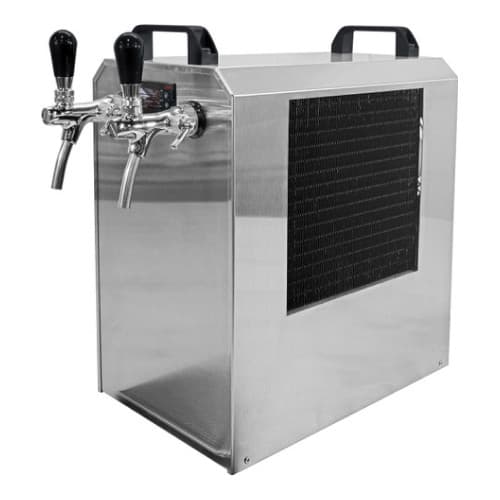
For outdoor events and mobile bars, a jockey box is often the simplest dispensing option because it uses ice rather than power. For compact counter service where power is available, a portable beverage dispenser such as a Mobichill unit can be a better fit.
The Core Equipment Checklist
1. Keg or beverage source
The keg holds the beer or draft beverage. Most commercial beer kegs use a Sanke-style valve, while many homebrew, small-batch, soda, cocktail, and sparkling water setups use Corny kegs with ball-lock posts.
Before choosing fittings, confirm the keg type. A Sanke keg needs a matching coupler. A Corny keg needs separate gas and liquid quick disconnects.
Relevant Purotap products:
2. CO2 tank
CO2 pushes beer from the keg through the beverage line and toward the faucet. It is not just for carbonation. Even fully carbonated beer still needs dispense gas to move through the draft system.
For many small mobile setups, a 5 lb CO2 tank is a practical starting point because it is portable while offering more capacity than a very small cylinder. Lighter use can work with a 2.5 lb tank, while high-volume events may need backup tanks.
Compressed gas cylinders should be treated as safety equipment. OSHA guidance for compressed gas cylinders emphasizes keeping cylinders upright and secured to reduce the risk of damage, tipping, and leaks.
Relevant Purotap products:
3. Regulator
The regulator controls gas pressure from the CO2 tank to the keg. Without a regulator, pressure cannot be controlled safely or consistently.
Pressure depends on beer temperature, carbonation level, line restriction, coil length, and desired pour speed. For coil-style jockey boxes, the Brewers Association Draught Beer Quality Manual gives higher pressure ranges than a normal kegerator because the beer has to travel through long coils with significant resistance. For 120 ft coils, the manual notes 35 to 40 psi as a common operating range, while shorter coils may use lower pressure. Treat these as setup references, not universal values.
4. Coupler or ball-lock disconnects
The keg connection is where many draft setup mistakes happen.
Use a Sanke coupler for a standard commercial beer keg. Use ball-lock gas and liquid disconnects for Corny kegs. The gas-side fitting connects CO2 to the keg, and the liquid-side fitting connects beverage from the keg to the dispenser.
Relevant Purotap products:
5. Beverage line and gas line
The gas line carries CO2 from the regulator to the keg. The beverage line carries beer from the keg to the dispenser. For mobile service, line routing should be short, clean, protected from direct sun where possible, and matched to the coupler, disconnect, or jockey box inlet.
If the line setup is wrong, beer can pour foamy, flat, slow, or inconsistent. Micro Matic's draft maintenance guidance also emphasizes balancing system restriction to applied pressure, which is one of the main ideas behind stable draft performance.
6. Jockey box or portable beer dispenser
This is the dispense and chilling point.
A jockey box runs beer through stainless coils inside an ice bath. The Brewers Association describes jockey boxes as temporary dispensing systems where beer passes through a cold plate or stainless coil submerged in ice. Coil-style jockey boxes are useful when faster pour rates and higher volumes are needed.
A powered portable beer dispenser uses refrigeration instead of an ice bath. This can be useful for tasting counters, small commercial counters, home draft setups, and mobile service where power is available and ice handling is less desirable.
Purotap options:
- Jockey Box Picnic SS Cooler, 54QT
- Jockey Box Picnic SS Cooler, 65QT
- Jockey Box Picnic SS Cooler with Tower
- Mobichill 25K Portable Beverage Cooler
- Mobichill 40K Portable Beer Cooler
- Mobichill 55 Portable Beer Cooler
7. Faucet and serving hardware
The faucet is the final dispense point. On many jockey boxes, the faucet is built into the cooler or tower. For mobile service, choose faucet count based on the number of beverages and how quickly guests need to be served.
One faucet can work for a single beer or lower-volume service. Two faucets are better for events where you are pouring two products, reducing wait time, or serving a larger crowd.
8. Ice, power, and event logistics
The right chilling plan depends on the dispenser.
For jockey boxes, plan for enough ice and water to fully submerge the coils. The American Homebrewers Association recommends chilling the coils with ice and cold water rather than using only ice. KegWorks' jockey box instructions also emphasize that warm kegs create foam and that coils should be submerged in an ice and water bath during use.
For powered portable dispensers, confirm access to power, space around the unit, and the number of product lines needed.
9. Cleaning supplies
Draft equipment needs cleaning after use. The Brewers Association warns that temporary dispensing equipment should be cleaned immediately after use because old beer left in lines can lead to mold and biofilm problems. Micro Matic also recommends regular beer line cleaning and disassembling and cleaning couplers and faucets as part of proper draft maintenance.
For mobile operators, cleaning is not optional. It protects flavor, reduces odor, and helps keep the system ready for the next event.
Jockey Box Setup: The Practical Flow
A typical mobile beer setup with a jockey box follows this order:
- Confirm the keg type and coupler or disconnect.
- Secure the CO2 tank upright.
- Connect the regulator to the CO2 tank.
- Connect gas line from regulator to keg.
- Connect beverage line from keg to jockey box inlet.
- Run beer through the coils before fully icing if the system was recently rinsed.
- Fill the cooler with ice and water so the coils are submerged.
- Start at a reasonable pressure for the coil length and adjust for pour quality.
- Check all fittings for leaks.
- Clean and dry the lines after service.
Common Mobile Draft Problems
Foamy beer
Common causes include warm keg temperature, warm lines, pressure mismatch, poor coil contact with ice water, or a keg that was shaken during transport. Warm beer is one of the biggest causes of foam.
Slow pours
Slow pours can come from low pressure, a partially blocked line, incorrect connection, frozen lines, or excess restriction.
Leaks
Leaks often happen at couplers, disconnects, regulator connections, or compression fittings. Check connections after the system cools because seals and fittings can shift slightly.
Beer tastes stale
Old beer in lines, poor cleaning, warm storage, and dirty faucets can damage flavor. Clean immediately after events.
Best Setup by Use Case
Small private event
Use a single-faucet jockey box or compact portable dispenser. A 2.5 lb or 5 lb CO2 tank can work depending on event length and backup needs.
Wedding or catered event
Use a two-faucet jockey box or powered dispenser with enough output for peak service. Bring backup CO2 and verify keg connections before the event.
Beer festival or high-volume outdoor service
Use a larger jockey box with longer coils and multiple faucets. Plan ice, spare fittings, line cleaning, and keg temperature carefully.
Tasting counter or indoor pop-up
Use a powered portable dispenser if power is available and the footprint needs to stay compact.
Research Sources
This guide was informed by the Brewers Association Draught Beer Quality Manual, the Brewers Association PDF section on jockey boxes, the American Homebrewers Association jockey box guide, Micro Matic draft beer maintenance guidance, KegWorks jockey box instructions, and OSHA compressed gas cylinder guidance.
Frequently Asked Questions
What equipment do I need for mobile draft beer?
You need a keg, CO2 tank, regulator, coupler or ball-lock disconnects, gas line, beverage line, a jockey box or portable beer dispenser, faucet, and beer line cleaning supplies. The exact fittings depend on whether you use a Sanke keg, Corny keg, jockey box, or powered dispenser.
Do I need CO2 for a jockey box?
Yes. A jockey box chills and dispenses the beer, but CO2 is still needed to pressurize the keg and move beer through the coils to the faucet. The pressure setting depends on coil length, beer temperature, line setup, and desired pour speed.
What size CO2 tank should I use for mobile draft beer?
A 5 lb CO2 tank is a practical starting size for many mobile draft beer setups because it balances portability and capacity. A 2.5 lb tank can work for lighter service, while busy events should have backup CO2 available.
Is a jockey box or portable beer dispenser better for events?
A jockey box is usually better for outdoor events where ice is available and power is limited. A powered portable beer dispenser is often better for compact indoor counters, tasting stations, or mobile setups with reliable power.
Can mobile draft beer equipment dispense wine, cocktails, soda, or sparkling water?
Yes. Many draft systems can dispense beer, wine, soda, sparkling water, draft cocktails, and other kegged beverages when the gas, pressure, fittings, and cleaning process are matched to the beverage.
How soon should I clean mobile draft beer equipment?
Clean mobile draft equipment immediately after service. Beer left in lines, coils, faucets, or couplers can cause off-flavors, odor, biofilm, and sanitation problems.